
Achieving long-term growth is not about earning a lot of money. For investors in India, allowing investments enough time to grow can make a meaningful difference. This creates a cycle where your money makes money.
Using compound interest helps people reach their life goals faster. By reinvesting the profits you make, you build a foundation for the future. Today anyone can access these tools.
Good financial planning is about being consistent not just timing the market. It turns amounts of money into big funds through steady habits. This way your money grows without needing effort.
Think of a snowball rolling down a hill getting bigger with each turn. This is the heart of building wealth today. Starting early gives your investments more time to grow.
Being consistent is key to success. Small monthly habits can lead to results over many decades. Your future self will thank you for the decisions you make today.
Key Takeaways
* Time can be a major advantage when building long-term wealth.
* When you reinvest the returns you make they create earnings.
* Starting early allows you to invest smaller amounts regularly over a longer period.
* Consistency is more important than trying to make a lot of money at
* Having a long-term view reduces the impact of market ups and downs.
Understanding Compound Interest. How It Helps You Build Wealth
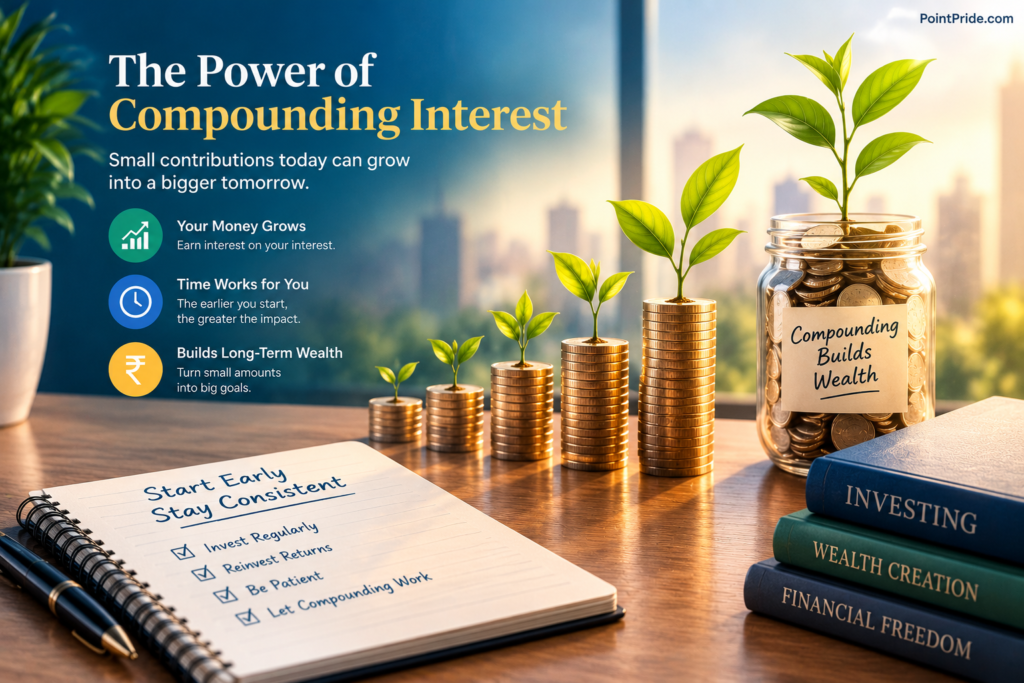
Understanding compound interest can help you see how reinvested returns may contribute to long-term growth. It means that the interest earned on an investment is added back to the investment. This creates interest over time.
What Is Compounding Interest and How Is It Different from Simple Interests
Compound interest is different from interest. Simple interest calculates interest only on the original amount you invest. Compound interest calculates interest on the original amount plus interest that has already been earned. This makes investments grow faster with compound interest.
For example, if you put ₹1,000 into an investment at a 5% rate, simple interest gives you ₹50 a year. With compound interest, the first year’s interest is ₹50. This makes the ₹1,050 for the next year earning ₹52.50 in interest.
The Formula for Compound Interest
The standard compound-interest formula is: A = P(1 + r/n)^(nt), where A is the final amount, P is the principal, r is the annual interest rate expressed as a decimal, n is the number of compounding periods per year, and t is the number of years.
* A is the money you have after n years including interest.
* P is the starting amount of money you invest.
* r is showing and prefer the interest rate (as a decimal). it shows the rate as a decimal
* n is how often interest is added each year.
* t is how long the money is invested for in years.
This formula shows how the frequency of compounding affects the amount of money you have.
Step 1: Understand the Compound-Interest Calculation
To use compound interest to your advantage, you need to know your wealth building goals. This means considering your goals, how long you can invest, and how much you can contribute regularly.
Figuring Out Your Starting Investment Amount and Monthly Contributions
First, figure out how much you can start with and how much you can put in each month. More money upfront and regular payments can greatly increase your returns over time.
For example, investing ₹1 lakh with a SIP of ₹5,000 can show different results based on the return rate and how long you invest.
Setting Financial Goals and Time Frames
Setting clear financial goals and time frames can make long-term wealth building easier to plan. Whether it is for retirement, a house down payment, or a child’s education, having goals helps you stay focused and motivated.
The time frame also matters because a longer period can give compounding more time to work.
Using Compound Interest Calculators
Compound interest calculators are tools for Indian investors to see their wealth building possibilities.
Online Tools and Mobile Apps
There are online tools and mobile apps that can help you figure out your returns. These platforms let you input your investment amount, expected return, and investment period to estimate the future value.
Some popular choices include Moneycontrol and Groww apps.
Manual Calculation Methods with Examples
If you like doing things by hand there are ways to calculate compound interest. The formula is A = P(1 + r/n)^(nt) where A is the amount P is the principal r is the annual interest rate n is how often interest is compounded and t is the investment time.
For example, ₹10,000 compounded annually at 8% for 5 years grows to about ₹14,693 before tax and fees, assuming the rate remains unchanged.
By using these methods, Indian investors can make investment choices and increase their wealth.
Step 2: Choose the Right Investment Vehicles
The investment vehicle also matters because different products have different risks, costs, liquidity, and return characteristics. In India there are options, each with its own benefits.
Fixed Deposits and Recurring Deposits
Fixed Deposits (FDs) and Recurring Deposits (RDs) are favorites in India and help investors work toward that goal. They offer a return perfect for those who like less risk.
Interest and Compounding Frequency
Interest rates for FDs and RDs vary by bank, product, tenure, and the time at which you invest. Some banks compound interest at regular intervals according to the product terms, so check the bank’s current terms before investing.
* Fixed Deposits: Usually they give rates for longer times.
* Recurring Deposits: You put in a set amount earning interest on it all.
Tax Implications
FDs and RDs have tax implications. Interest income may be taxable according to the applicable tax rules. You can get a tax break under Section 80C for some RDs.
Public Provident Fund (PPF) and Employee Provident Fund (EPF) are important long-term savings and retirement-oriented schemes for eligible investors and employees. Their rules, rates, tax treatment, and eligibility requirements should be checked against current official information.
PPF and EPF can support long-term saving, but they have different eligibility, contribution, withdrawal, and tax rules.
* PPF: the interest rate is notified by the Government and can change; the scheme also has specific contribution, maturity, and withdrawal rules.
* EPF interest rates are notified for the relevant financial year and can change; eligibility and withdrawal rules also depend on the applicable EPF provisions.
Tax and Withdrawal Rules
* Both PPF and EPF get tax breaks under Section 80C.
*. How you can withdraw money is different with PPF letting you take some out after a while.
Mutual Funds and Systematic Investment Plans
Popular Investment Options for Indian Investors
They offer flexibility. Consider spreading your investments across suitable mutual fund options.
Equity vs Debt Funds for Long-Term Growth
* Equity funds invest in stocks aiming for returns over time with stocks.
* Debt funds on the other hand offer stable returns from fixed-income securities.
SIPs let you invest a set amount regularly in SIP.
This helps smooth out market ups and downs by averaging your cost with SIP.
Rupee Cost Averaging
* Helps lower your cost over time with cost averaging.
* Disciplined Investing
* Encourages investing promoting a steady approach to investing.
National Savings Certificate and Sukanya Samriddhi Yojana
* They offer tax perks and good interest rates.
Step 3: Use Consistent Contributions and Long-Term Planning
Strategic planning and consistent action are the keys to unlocking the power of compound interest.
We’ve learned about compound interest. Choosing the right investments like PPF.
Now lets talk about how to get the most out of your returns.
Starting Early to Leverage Time as Your Greatest Asset
Compound interest is great for growing wealth over time with PPF.
Starting Early With PPF
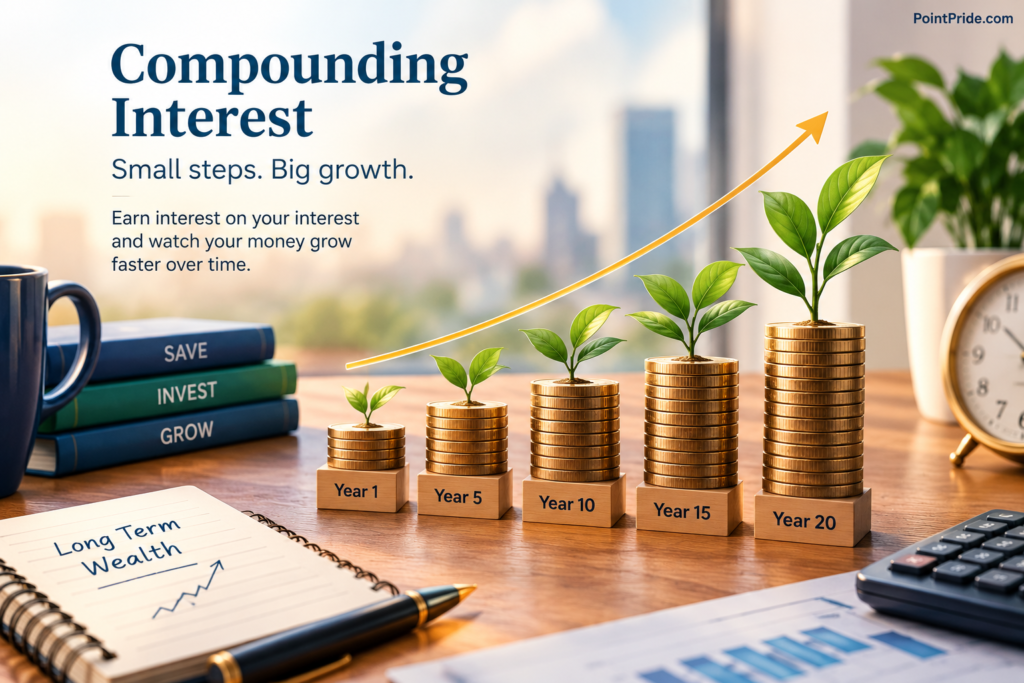
The sooner you start, the time your money has to grow in PPF.
The 20s vs 30s vs 40s Investment Comparison
A hypothetical illustration of starting early
Suppose you invest ₹1 lakh at the end of each year and earn a hypothetical 8% annual return. This is a mathematical illustration, not a PPF rate or a guaranteed investment return. Starting earlier gives each contribution more time to compound.
Age Started
* Starting at age 20 for 40 years: total contributions ₹40 lakh; hypothetical value at 8% annual return: about ₹2.59 crore.
* Starting at age 30 for 30 years: total contributions ₹30 lakh; hypothetical value at 8% annual return: about ₹1.13 crore.
* Starting at age 40 for 20 years: total contributions ₹20 lakh; hypothetical value at 8% annual return: about ₹45.76 lakh.
These figures assume ₹1 lakh is contributed at the end of each year and an unchanged 8% annual return. They are illustrations, not a prediction of PPF maturity or market returns.
Real Calculations Showing the Cost of Delayed Investing
The illustration shows why delaying regular investing can reduce the time available for compounding. Actual returns depend on the investment product, contribution timing, taxes, fees, and applicable rules.
The broader lesson is that starting earlier can give compounding more time to work; the exact outcome depends on the product and its applicable rate.
Increasing Your Contribution Frequency for Faster Growth
Investing often can speed up your wealth growth with Mutual Funds.
Frequent investments can make a big difference over time.
Monthly vs Quarterly vs Annual Contributions
For a fair comparison, compare the timing of contributions as well as the annual amount: investing throughout the year can produce a different result from investing the same total amount as one annual contribution because money is invested for different lengths of time.
The Impact of Regular Increments in Investment Amount
Increasing your investment regularly can boost compound interest with SIP.
This not increases your total investment but also grows your wealth faster.
Reinvesting Dividends and Interest for Accelerated Compounding
Reinvesting dividends and interest is a way to increase returns with investments.
This method ensures your returns keep growing helping you build wealth faster.
Avoiding Mistakes That Disrupt Compound Growth
Compound interest is powerful for wealth growth but mistakes can slow it down.
Knowing these mistakes is key to investing.
Early Withdrawals and Their Long-Term Impact
Withdrawing soon can hurt your long-term gains with investments.
It’s essential to avoid withdrawals to let your investments grow.
Inconsistent Contributions and Market Timing Errors
Consistency in investing is critical with SIP.
Irregular contributions and trying to time the market can reduce your returns. Harm your wealth-building journey.
Ignoring Inflation, Taxes and Fee Structures
Remember, inflation, taxes and fees can affect your investments like PPF.
Ignoring these can lower your returns. Reduce the benefits of compound interest.
Monitoring and Rebalancing Your Portfolio
Regularly check and adjust your investment portfolio to meet your goals.
This ensures your investments stay on track helping you manage risk and optimize returns.
Building wealth is easier when you know about compound interest with investments.
It’s a tool that grows your money over time.
The right investments and discipline are key.
To build wealth start early. Be consistent with investments.
Make choices and plan well.
This way you can achieve term financial success.
Remember, patience and persistence are vital.
Avoid mistakes. Keep your investments diverse.
Every step you take now can lead to gains later.

FAQ
What is the difference between simple interest and compound interest in wealth building?
* Simple interest only grows on the amount.
* Compound interest grows on the amount plus any interest already earned.
* This leads to growth over time with compound interest.
How does compounding frequency impact the maturity value of an investment?
* More frequent compounding means growth.
* For example a Fixed Deposit at HDFC Bank grows with quarterly compounding than annual.
Why is starting to invest in your 20s significantly more effective than starting in your 40s?
* Starting early gives compounding more time to work.
* An investor starting at 25 with ICICI Prudential Mutual Fund grows than one starting at 45.
* Early investors get time for growth.
Are there online tools available for Indian investors to calculate these returns?
* Yes many financial platforms offer compound interest calculators.
* Groww, Zerodha and ClearTax provide tools for planning.
* They show the difference between equity and debt instruments like PPF.
What are the tax advantages of using the Public Provident Fund for compounding?
* PPF is tax-efficient for long-term growth in India.
* Contributions are tax-deductible interest is tax-free. The final amount is tax-exempt.
* This keeps growth from being reduced by taxes.
How does a Systematic Investment Plan help with Rupee Cost Averaging?
* SIPs invest a fixed amount regularly.
* This strategy lowers your cost over time.
* It maximizes SIP benefits, with compound interest.
What common mistakes can disrupt the process of compound growth?
* Early withdrawals reset the compounding clock.
* Inconsistent contributions and ignoring inflation are also mistakes.
* High fees and not reinvesting dividends also hinder growth.
Can I achieve compound growth through the Sukanya Samriddhi Yojana?
* Yes, SSY can be used as a long-term savings option for an eligible girl child, subject to the scheme’s current rules.
* It offers interest compounded annually.
* Its long lock-in period ensures disciplined investing and compound growth.
How Often Should I Rebalance My Investment Portfolio?
* While patience is rewarded, annual monitoring and rebalancing are advised.
* This keeps your portfolio aligned with your goals.
* For example moving gains to NSC or SBI Recurring Deposit maintains risk profile.
Compound interest in Indian savings and investments
Primary sources: For current banking information, check https://www.rbi.org.in/; for mutual-fund and securities information, check https://www.sebi.gov.in/ and https://www.amfiindia.com/.